
Starship just reached orbit for the first time, carrying satellites for SpaceX’s Starlink program. Analysts disagree on whether that’s a detour or the destination — and what of the company’s plans for the Red Planet?
Ten years ago, Elon Musk stood on stage at the International Astronautical Congress (IAC) in Guadalajara, Mexico, and unveiled plans for a giant spaceship to carry people to Mars. This past Sept. 28 — a decade and a day later — the descendant of that vehicle reached orbit for the first time, on Starship’s 14th-ever test flight.
The designs and hardware evolved greatly over those 10 years. For example, the 2016 design, called the Interplanetary Transport System (ITS), employed carbon fiber, but this gave way to the stainless-steel Starship, which SpaceX began testing in 2019 with short hops from its Texas site. Prototypes flew to high altitude and landed, and some exploded, until SN15 stuck a landing in May 2021. That same year, NASA selected Starship as the first astronaut lander for its Artemis lunar missions.
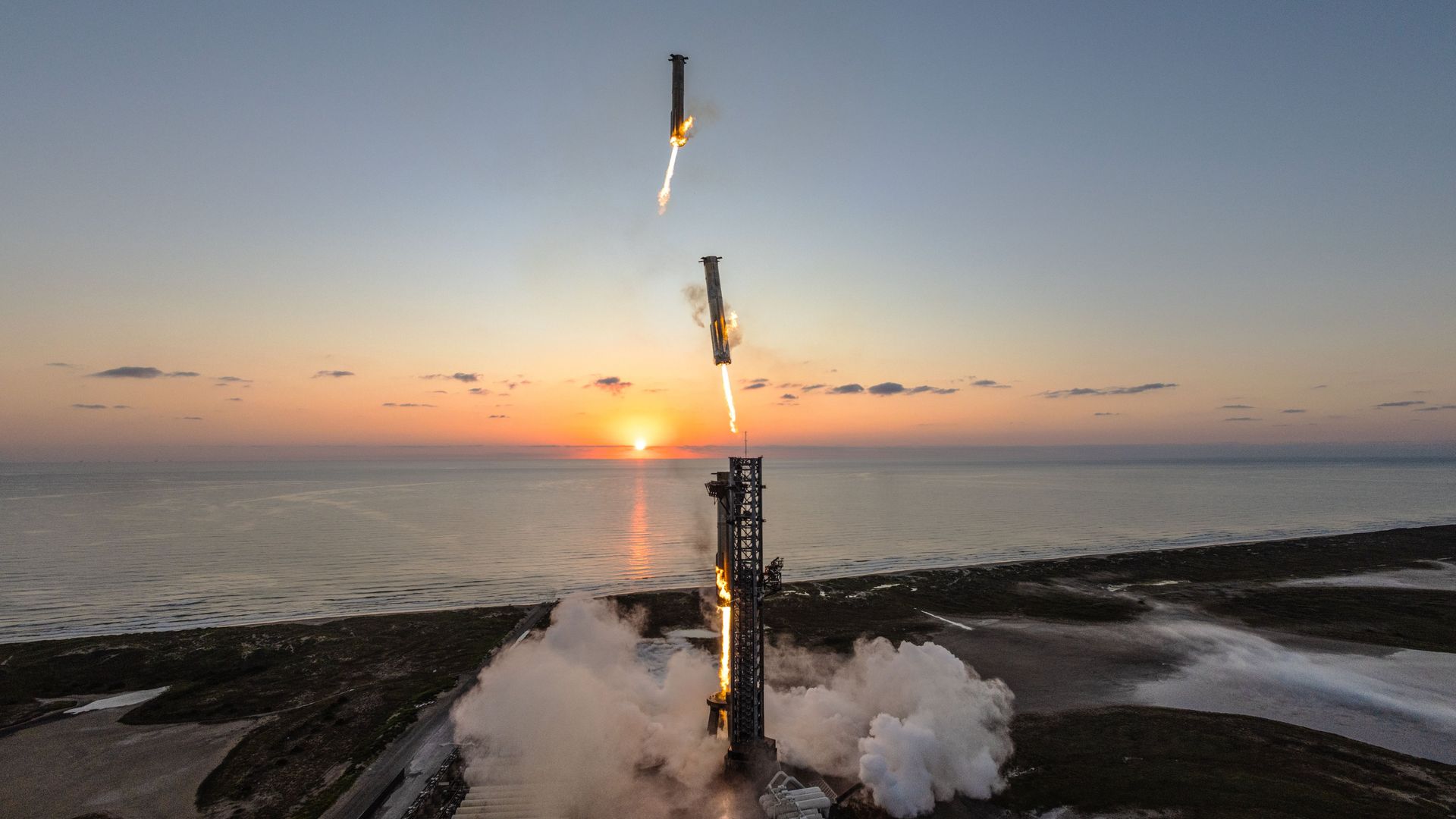
The full Starship stack — a Super Heavy booster with a Ship upper stage on top — first flew in April 2023 and failed within minutes. Three flights followed in less than a year, each reaching space, and each ending with Ship lost on reentry. During a 2024 test flight, SpaceX moved liquid oxygen between two tanks inside one Ship, the closest it has come to the propellant transfer that any mission to the moon or Mars will require. In June of that year, the company brought both stages down in controlled splashdowns, and that October the launch tower’s mechanical arms caught a returning Super Heavy booster for the first time.
Progress wasn’t linear, however. After a booster catch in January 2025, a string of Ship failures followed, and one upper stage exploded during ground testing that June. A clean flight in August 2025 helped break the streak, and by that October, SpaceX flew the last of the older design. The first Starship V3 launched in May 2026. Another went up in July, and Flight 14 followed on Sept. 28.
‘A different beast’
“ITS was definitely a different beast,” said Matija Renčelj of the European Space Policy Institute (ESPI). “Yet, we have to acknowledge two trends that both attest to SpaceX’s agility and increasingly market-first rather than vision-first outlook.”
“The gap between ITS and Starship is real, but I would not consider that a failure,” he said.
In his view, the rocket is mainly a business tool. “The rocket is the means, not the end,” Renčelj said, adding that its main role now is cutting Starlink deployment costs. SpaceX currently operates a constellation of more than 11,000 Starlink broadband satellites, almost all of which were launched by its workhorse Falcon 9 rocket. But Starship Flight 14 lofted the first members of the next-gen Starlink V3 constellation, which will eventually consist of 100,000 spacecraft, if all goes to plan. Starlink V3 satellites are bigger and heavier than their predecessors and can only be launched efficiently by Starship.
Renčelj said the moon focus reflects Washington’s priorities and SpaceX’s interest in staying central to NASA’s Artemis program, and in reassuring investors after the company’s acquisition of xAI this past February and its IPO, which occurred in June.
Joseph Gonzalez, a University of Illinois Grainger College of Engineering aerospace professor who spent about a decade working on Artemis, sees it differently.
“I think SpaceX is still very much targeting Mars,” he said. “SpaceX continues to stress making humanity multiplanetary and establishing a self-sufficient city on Mars as long-term objectives.” Gonzalez sees the moon as a proving ground rather than a replacement. Just days away from Earth, the moon lets engineers find problems “before committing humans to a Mars mission.”
“Space exploration takes time, especially when you are developing a human spaceflight system with this level of complexity,” Gonzalez said. “They build, fly, learn, make changes and fly again. That creates very visible successes and failures, but it also allows engineers to accumulate flight experience and data quickly.”
Challenges remain
Reaching Earth orbit isn’t the hard part for Starship. Gonzalez said that the most underrated gap is the large-scale cryogenic propellant transfer between vehicles once in orbit. SpaceX has moved propellant between tanks in one Ship before, but its architecture requires numerous transfers involving tanker ships to refill a fuel depot, which a Ship must visit in order to make journeys to the moon or Mars. Gonzalez described this depot as a gas station in space, but there are challenges typical gas stations don’t face. The fuel is extremely cold, for example, and it needs to be moved in microgravity conditions.
That milestone is yet to happen, and the timeline for an attempt is not clear. It could potentially come with Flight 15 and 16. These were aspirationally scheduled for no earlier than mid and late October, respectively, but have now apparently slipped to mid-to-late November (though there has been no public confirmation of any firm target date).
In 2025, Musk said there was a “50/50” chance of Starship making a run for Mars in 2026. However, with the once-every-26-months Mars launch window — which lasts a few weeks, opening in late October — and no propellant transfer demonstration yet in the books, that is off the table. The next such low-energy orbital transfer opportunity for the Red Planet opens in late 2028, running into early 2029. At the same time, NASA is currently targeting late 2028 for its Artemis IV mission — which involves Starship — to return humans to the lunar surface after an absence of more than 50 years, giving SpaceX a challenging deadline toward which to work. The company will need to dedicate key resources to meet that timeline, including developing life support systems for crew.
For now, Starship’s most immediate role is hauling Starlink satellites in orbit. Renčelj noted that startups raising billions are betting on Starship delivering low super-launch prices along with Falcon 9-like reliability. “Their business models are underpinned by what might be a single point of failure,” he said.
“Starship still has major capabilities to demonstrate before it can perform the complete missions envisioned for the moon and Mars,” said Gonzalez.
“So I would say the timelines are comparable considering the ambition of the vehicles,” he added. “The bigger difference isn’t necessarily how many years they have taken, but it’s where and how each program chooses to learn during those years.”
Musk has repeatedly talked of getting thousands, or even hundreds of thousands, of people on Mars “to make life multiplanetary.” Most immediately, SpaceX has a number of business goals and lunar commitments to adhere to ahead of a first uncrewed visit to Mars. Late 2028 appears to be the next real opportunity.