
NASA’s Artemis IV moon mission will be a complicated affair — especially if SpaceX’s Starship ends up being the lunar lander.
For all of the changing components of the Artemis program over the past several years, one of its most persistent may be the question of how many refueling flights Starship will need to land astronauts on the moon.
By summer 2021, it was common knowledge that Starship would require multiple launches to pull off an Artemis moon landing. A Government Accountability Office audit at the time, for example, estimated that it could take up to 16.
Earlier this month, a member of the Aerospace Safety Advisory Panel said the refueling number could be as high as 22. But that estimate was quickly refuted by SpaceX founder and CEO Elon Musk, who posted on his social media platform, X, that it would actually be closer to six or eight.
Perhaps an even bigger head scratcher, though, is how the refueling process will be carried out. Where (and when) will Starship’s upper stage gas up when it’s off planet? NASA released a graphic during a recent Artemis update that outlined an order of operations for the spacecraft on Artemis IV, which will be the program’s first crewed lunar landing.
The mission will launch a Space Launch System (SLS) rocket with the four Artemis IV astronauts aboard NASA’s Orion capsule to high Earth orbit, where they will rendezvous and dock with the Starship lunar lander.
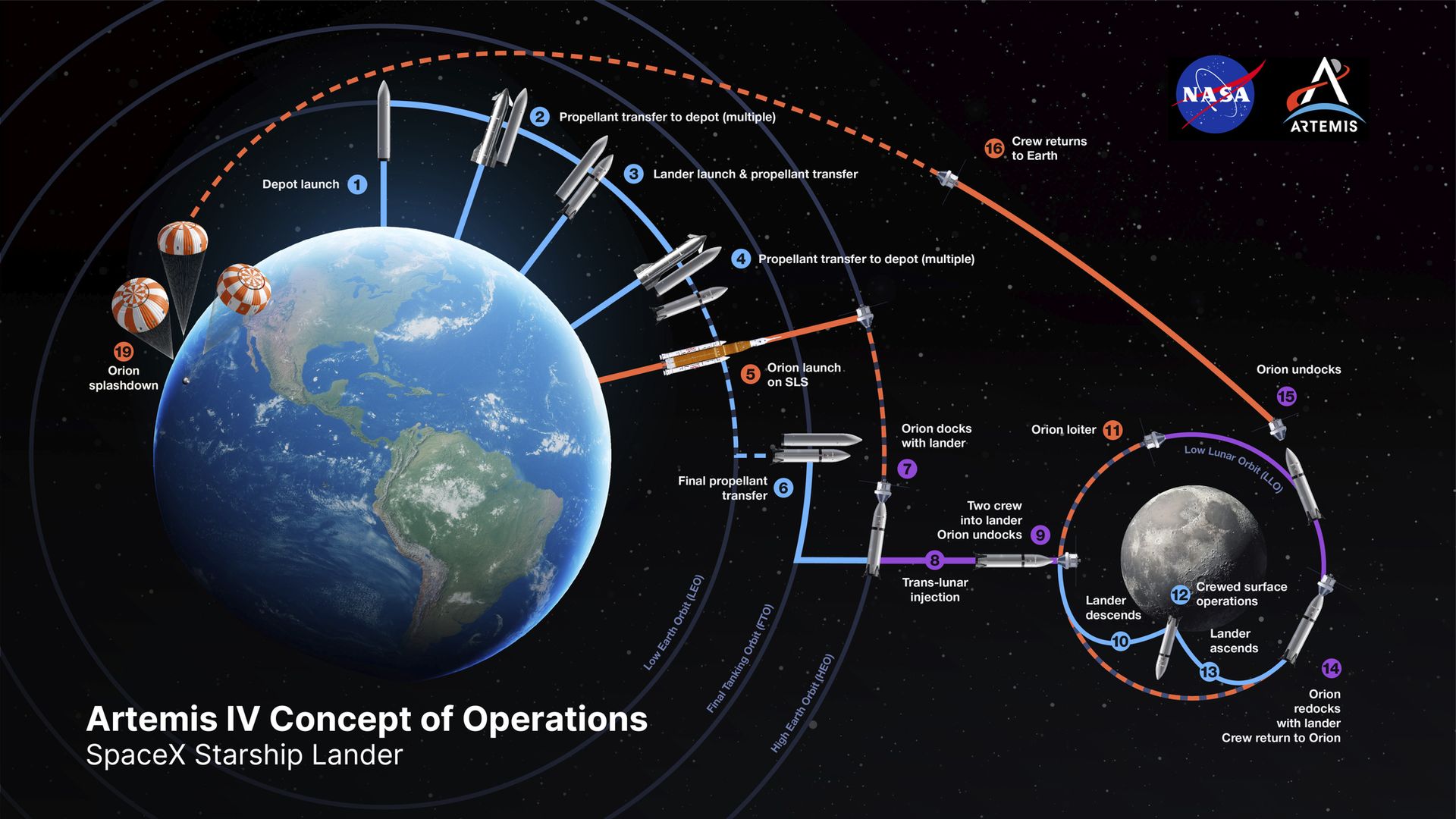
Using Starship’s engines, the two spacecraft will burn for the moon, and separate upon their arrival in low lunar orbit. Two astronauts will remain aboard Orion, while the other two will head down to the lunar surface in Starship.
After a little run through the regolith and a celebration of America’s triumphant return to the moon, the duo will board Starship again to launch back to lunar orbit and dock with Orion before beginning the trip back to Earth.
All that seems well and good for a mission to the moon, and even has some resemblances with missions from NASA’s Apollo days. What doesn’t seem as immediately obvious when mapping out the Artemis IV mission outline, though, are the steps that Starship will be taking during its refueling process before the astronauts ever make it to space.
Orion will rendezvous with Starship in high Earth orbit — but that’s not where the lander will launch initially. According to NASA’s Artemis IV outline, SpaceX will first launch a depot ship to low Earth orbit (LEO), which will serve as the repository for all the fuel the Starship lander will eventually need.
The graphic shows a tanker Starship docked with the depot with “(multiple)” written next to it, so we don’t know how many refueling flights will be needed for this initial depot fill. Once that’s done, SpaceX will launch the Starship lunar lander to join the depot in LEO for its first pit stop.
Then, and this is where some of the head scratching begins, Starship will undock from the depot and raise its altitude to what NASA has labeled the “final tanking orbit,” or FTO.
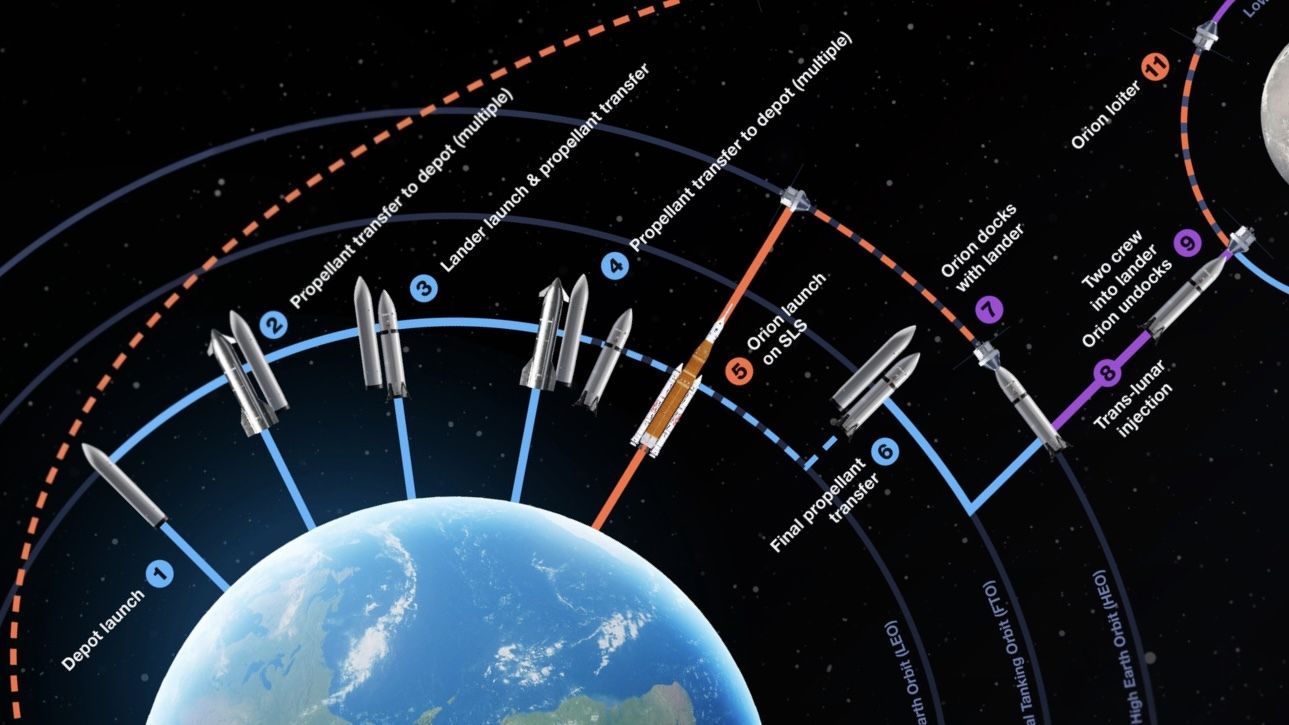
At some point after the Starship lander departs LEO, SpaceX will launch another round of “(multiple)” tanker ships to fill the depot with even more propellant. It will apparently then send the depot to meet the lander for another refill in FTO, where, as the name suggests, the two will dock for the pair’s final fuel transfer.
After bidding the depot a second farewell, Starship will ascend to high Earth orbit to meet Orion.
NASA’s graphic shows SLS launching Orion before Starship gets the last of its fuel, and the agency’s website explainer for Artemis IV says the unusually choreographed order of operations for the mission does serve a purpose.
However many fuel boosts Starship ends up needing to get from LEO to the surface of the moon, its staggered orbital staging will apparently create some flexibility around when SLS can launch the Artemis IV astronauts to begin their mission.
And while Starship’s orbital dance seems unnecessarily complicated, NASA says the new approach will actually reduce the amount of fuel SpaceX needs for the mission.
That’s partly because Starship will take Orion directly to low lunar orbit, instead of the much higher orbit envisioned in previous mission plans.
But keep in mind: None of this is set in stone. If SpaceX can’t demonstrate that its orbital refueling strategy works, or if it can’t pull off an uncrewed lunar landing mission by the end of next year, NASA could still select Blue Origin‘s Blue Moon lander for Artemis IV — assuming Blue Moon is able to check its required boxes in time. Regardless of which company’s lander delivers the first Artemis astronauts to the moon’s surface, exactly how the pieces of those missions will come together should become clearer as the launch date gets closer. So, while SpaceX’s refueling remains an open one for the time being, it’s one of many for which we’ll soon have an answer.