
The pace is picking up on building, testing, and plotting out the flight paths for a trio of NASA Ingenuity-class helicopters to investigate Mars after riding there on a nuclear-powered rocket.
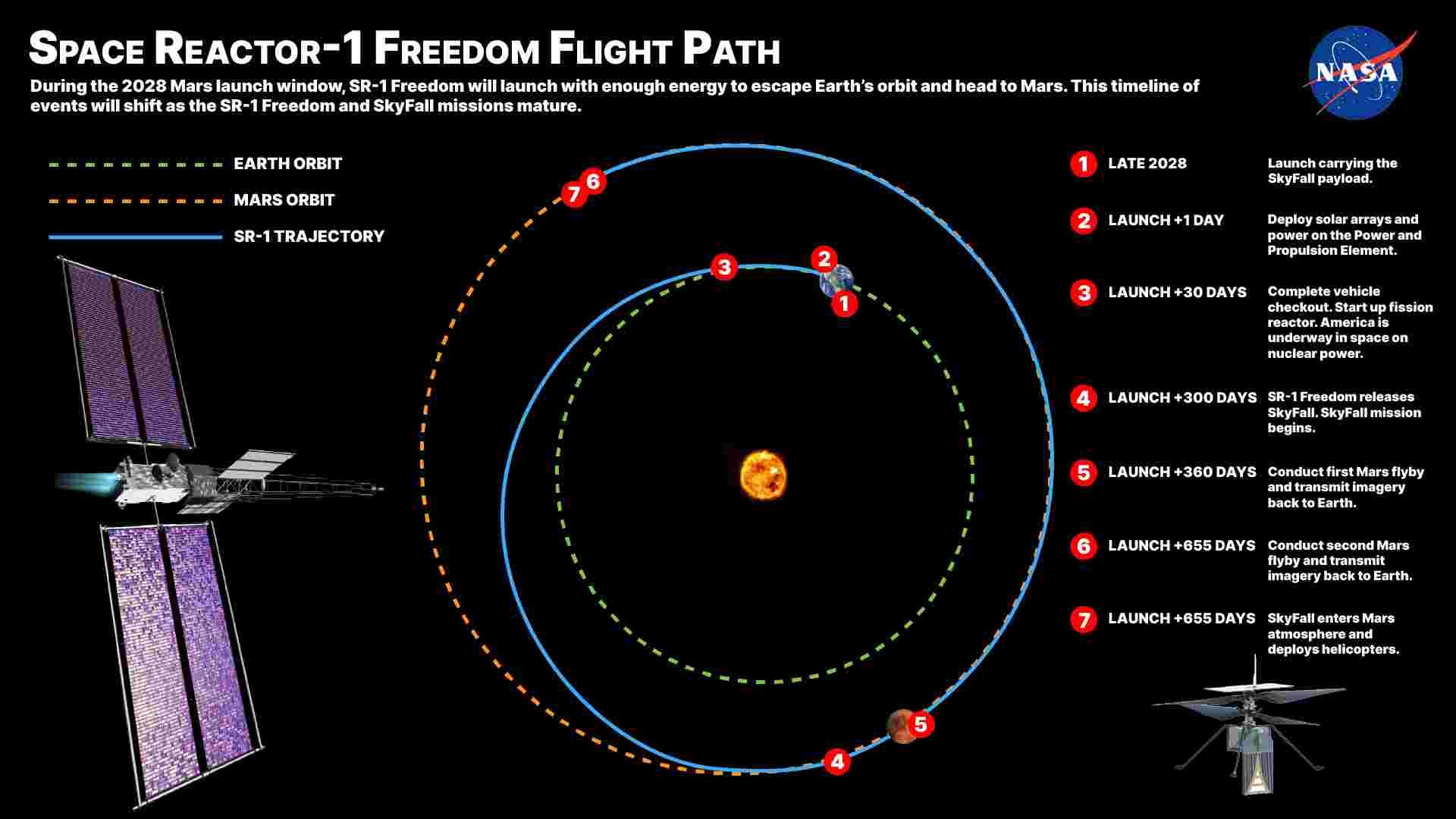
NASA’s Skyfall mission will see those mini-choppers dropped off at Mars by the space agency’s Space Reactor-1 Freedom (SR-1) rocket, the first fission nuclear-powered interplanetary spacecraft slated for launch in late 2028. After its cruise phase and initial Mars flyby in 2029, that nuclear carrier craft will make a second Mars approach in the Fall of 2030 to unleash a SkyFall entry capsule outfitted with a fleet of small aerial vehicles that will soar across the Red Planet.
But some experts are questioning why NASA is combining two such high-profile missions into one. “It is clear that SkyFall was approved for programmatic or political reasons,” said Scott Hubbard, former director of NASA’s Ames Research Center and the first Mars Program Director (aka the “Mars Czar“) at NASA Headquarters, told Space.com. “The connection to Space Reactor-1 seems to me to be a bit of a shotgun marriage, a tech-demo piggybacking on another mission as an opening bid for a ‘nuclear NASA.'”
Shotgun marriage?
Hubbard is a retired adjunct professor of aeronautics and astronautics at Stanford University. He is a major voice in shaping Red Planet exploration goals, drawing upon his expertise as NASA’s former foremost Mars authority. His understanding is that the basic concept had been developed as a follow on to Ingenuity, an attempt to move beyond a technology demo and into a science platform.
Hubbard said that combining these two observations, the outcome presents “an unusual set of management issues.” Since the SkyFall mission concept first appeared, he said, the usual sequence for a science mission is reversed.
“The science community is having to scramble to back into a set of requirements and objectives that match the SkyFall capabilities. Fortunately the community is very creative,” said Hubbard, “and the basic Planetary Decadal objectives are very broad.”
Decadal surveys reflect a broad consensus within the scientific community and provide detailed insights into the strategic priorities and mission directives set for the next decade across key scientific domains, including planetary exploration.
Lemonade squeeze
However, Hubbard said he has heard griping about the “fait accompli” process, “but the planetary community will make lemonade.”
It should be noted however, Hubbard continued, that this process is not how you would design a strategic set of missions as precursors for human exploration.
“SR-1 Freedom is a technology demo that may or may not be ready for the Mars launch window in 2028. It is clear that the Mars Program has a standard launch concept in their back pocket,” said Hubbard. “Nuclear Electric Propulsion [NEP] is of little value in traveling to Mars, not shaving any time off the transit. The real value of NEP is for risk reduction, use at the moon, outer planets and even bolder ideas like interstellar travel,” Hubbard concluded.
Resolution gap
“This, by far, is the shortest Mars mission ever conceived of,” said Matthew Golombek, SkyFall Project Scientist at NASA’s Jet Propulsion Laboratory in Pasadena, Calif., speaking Nov. 10 during the virtual meeting of the Mars Exploration Program Analysis Group (MEPAG).
Kick-started by NASA in March 2026, the SkyFall project has grown from roughly six people to over 200 individuals who are now working on the initiative, said Golombek. “This is an incredibly rapid development and build,” he said.
“It’s really to demonstrate that exploration is possible with helicopters … filling what I call a ‘resolution gap’ between orbital information and surface information,” Golombek told the MEPAG.
Once deployed by a helicopter deployment system, the threesome will spin up their rotors at about a kilometer above the surface of Mars. Then each helicopter lands on its own, ready to undertake flights every other solar day on the Red Planet. On average, a day (labeled as a sol) on Mars lasts 24 hours 39 minutes 35 seconds, from one noon to the next.
Scientific tasks
SkyFall’s prime mission is six months, with a one-year goal,” Golombek said, and the intent is to arrive in northern spring on Mars, a time where the vehicles are unlikely to encounter dust storms.
On the to-do list of NASA level one science requisites are for the helicopters to capture high-resolution imagery, perform a set scientific tasks, and help to prepare for future human exploration of Mars, said Golombek.
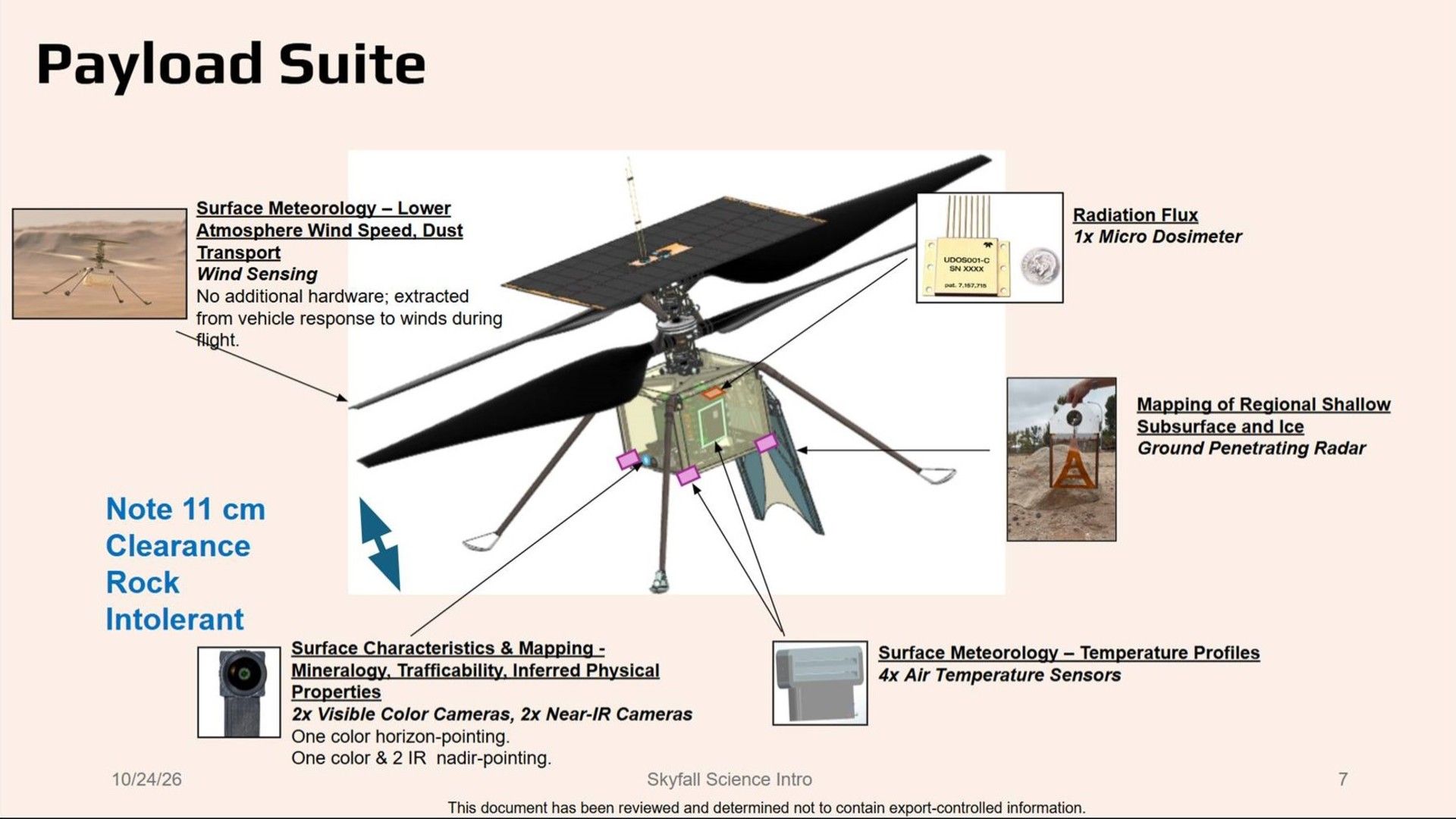
From their initial landing spots, the whirlybirds could potentially go tens to 100’s of kilometers or more in different directions. Identical for all three helicopters, the nominal payload consists of five instruments, plus engineering navigation cameras.
That gear can examine the subsurface structure of Mars, the geomorphology and geology of surface terrains, as well as look at the meteorology of the atmosphere and the planet’s radiation environment.
Star of the show
“The real star of the show is ground penetrating radar [GPR] with a flexible antenna,” Golombek noted. That ultra-small GPR hardware can look for buried rocks, the layering of the Mars home turf, as well as spot subsurface ice deposits.
“If you have this aerial access and the ability to scout ahead,” Golombek said, “you would go a long way towards better defining where to go with a rover and what kind of more detailed surface studies to do with subsequent missions.”
All that said, yet to be plotted out are science-focused traverses for the SkyFall helicopters. But there are early ideas.
“The real kicker is that these spacecraft are the smallest landers ever attempted on Mars,” said Golombek. “You are looking for a place that virtually has no rocks,” he pointed out, a must-have to assure high probability of landing safely. So toss in for good measure low surface slopes, no big craters, a site not overloaded with dust.
Design reference target
One early idea is to revisit the crash locales of discarded SkyFall descent hardware – fuel tanks, cruise stage and associated gear – equipment large and heavy enough to survive entry, smack into the Mars landscape and high-speed and generate craters.
“So if there is ice at centimeters depth, we would create our own icy impact craters,” Golombek said. “We could actually visit them in a time-scale before the ice actually sublimates,” he said.
Another site getting the eye, albeit deemed a design reference target but considered a “pretty good spot,” is within Arcadia Planitia in Mars’s northern lowlands. Studies have indicated the presence of substantial volumes of near-surface excess ice there.
“There is a vast amount of information to suggest large quantities of regional ice deposits at that location,” said Golombek. “This is at least one location that appears to meet all the engineering constraints and would be a potentially safe landing site…virtually no rocks,” he advised.
In the past, Golombek added, JPL took part in SpaceX-sponsored workshops to look for ice deposits as close to the equator of Mars that could be found. Arcadia Planitia was flagged as superior Starship touchdown terrain.
“Most of the landing sites considered for humans have talked about going to places with ice deposits. Ice provides both a consumable as well as fuel to get back off the planet,” said Golombek.
On-time delivery
For the near-term, scientific community input next year — via two workshops — are on tap, reviewing the science of SkyFall and also help sort out potential landing sites for final decision-making at NASA Headquarters.
Meanwhile, as SkyFall literally spins up, there is the need for on-time delivery of Space Reactor-1 Freedom.
Golombek said NASA considers the two endeavors as a pair.
“If SR-1 is not ready, SkyFall could be launched on any conventional launch vehicle without any difficulty whatsoever,” said Golombek, “something like a Falcon 9 would be more than sufficient, but others are possible as well.”