
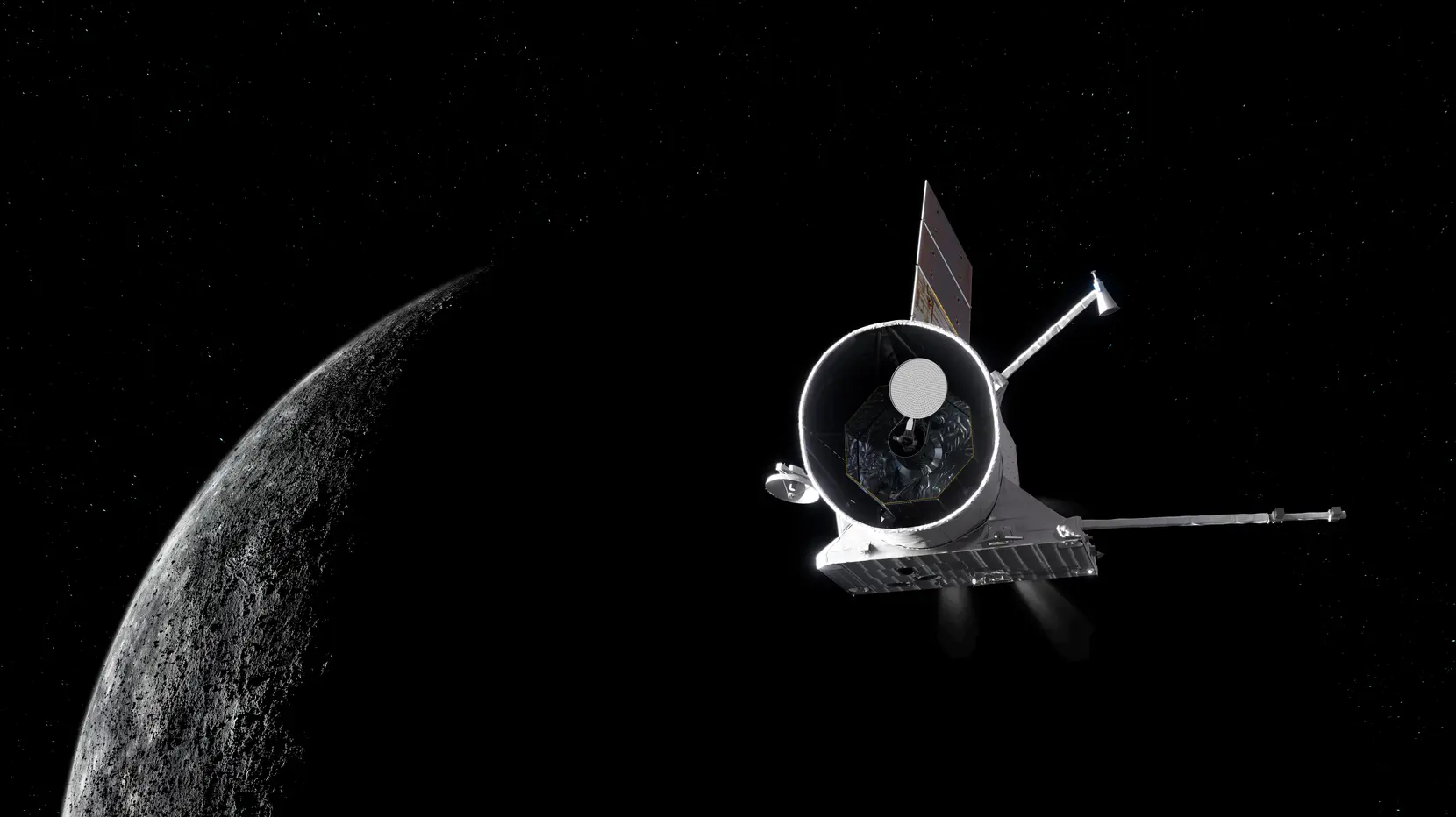
On 21 November, starting at 18:24 UTC, BepiColombo achieved Mercury orbit insertion (MOI), the second major milestone of its planetary arrival phase. As soon as the signal from the spacecraft was re-established after a scheduled loss of contact, the Mission Control Team at the European Space Operations Centre (ESOC) in Darmstadt, Germany, saw that the spacecraft had entered safe mode.
An issue occurred during the thruster burn, causing the manoeuvre to end earlier than expected. Since then, teams at ESOC have been working around the clock with lead spacecraft manufacturer Airbus and colleagues across the joint ESA and Japan Aerospace Exploration Agency (JAXA) mission to investigate the issue, which has been traced to a software glitch.
BepiColombo is safe and in a stable orbit around Mercury – an important milestone after its eight-year journey to the planet – and is on track for the separation of its two science orbiters on 9 December in Germany (10 December in Japan).
The mission also delivered a first: entering orbit around another planet using ‘weak stability capture’. This involves arriving at lower speeds than is typical for planetary missions, and is a technique that has previously only been used by some spacecraft travelling to Earth’s moon.