
Growing plants in space? Yes indeed! NASA astronauts are conducting botany experiments aboard the International Space Station (ISS).
What is it?
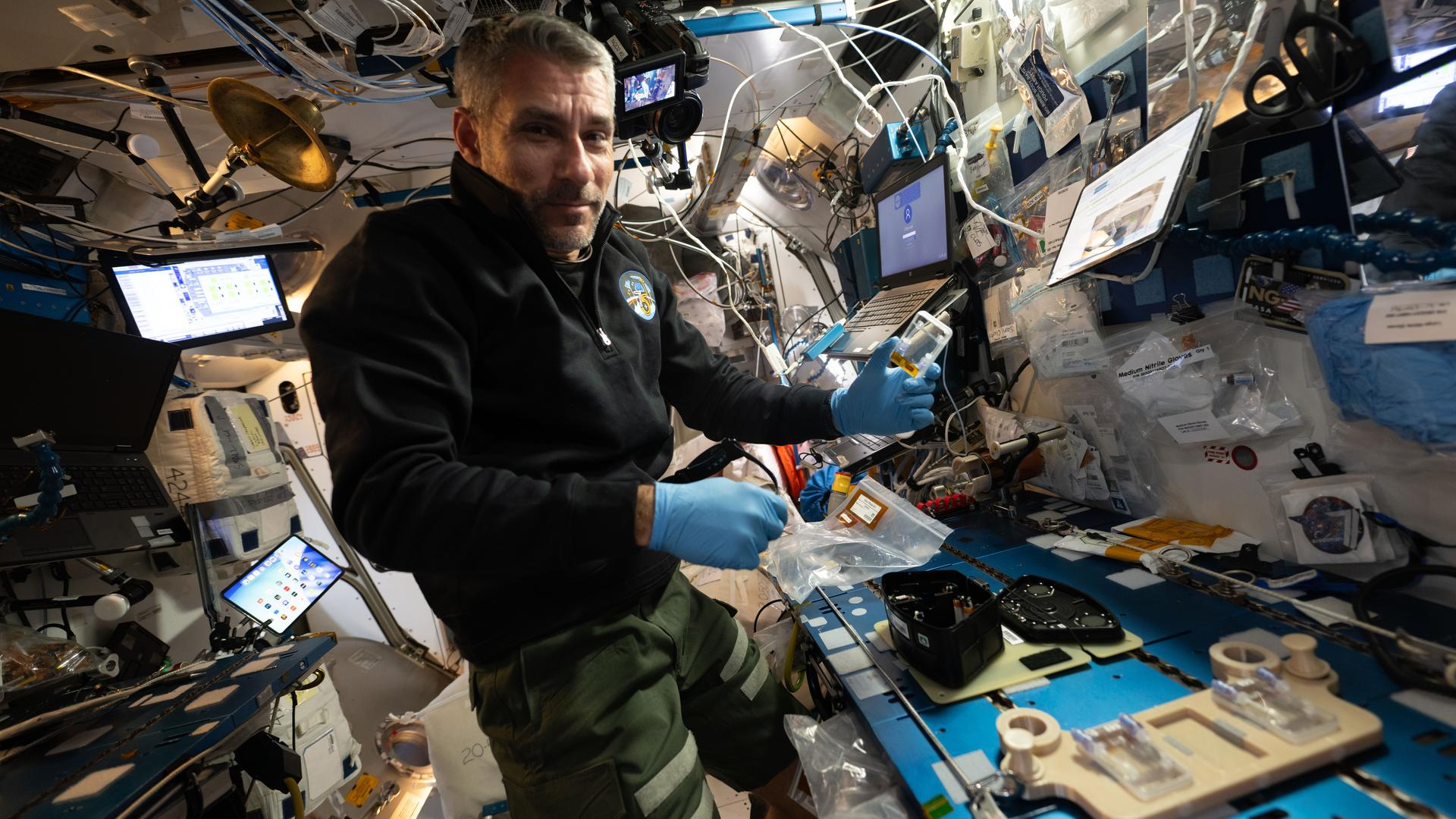
In this snapshot — captured by NASA astronaut Jessica Watkins, commander of SpaceX‘s Crew-13 mission to the ISS — we can see fellow NASA spaceflyer Luke Delaney hard at work aboard the ISS. And while he’s orbiting around our planet aboard a laboratory in the vacuum of space, he’s also growing plants.
In the photo, Delaney is working petri dishes and experiment modules that support our growing understanding of how plants grow in the microgravity environment aboard the station. Specifically, the experiments Delaney is working on will investigate the genetic responses of plants in this environment.
This is not the first time that researchers have studied plants in space. In fact, ISS astronauts have conducted a wide variety of plant experiments and investigations over the years. They’ve grown peppers and other edible produce and even proved that moss can survive outside the station, in the harsh environment of space.
Why is it incredible?
When you picture the inside of an orbiting space station, you might imagine the white and gray walls with computers, buttons, switches and other such tech speckling the scene. But the space station is also full of (non-astronaut) life, thanks to the incredible variety of biological experiments onboard.
While space is “the final frontier,” and we look outward to study everything from black holes to exploding stars, outer space can also help teach us about own planet. Satellites look back at Earth, studying its changing landforms, migrating wildlife, diminishing glaciers and natural disasters. Onboard the ISS, astronauts conduct experiments with plants, animals, microscopic organisms and an incredible amount of studies supporting human health and medical care. While space might be the final frontier, so much of the work done in space is designed to benefit us back here on Earth.