
The first Starship upper stage that SpaceX ever successfully recovered won’t fly again.
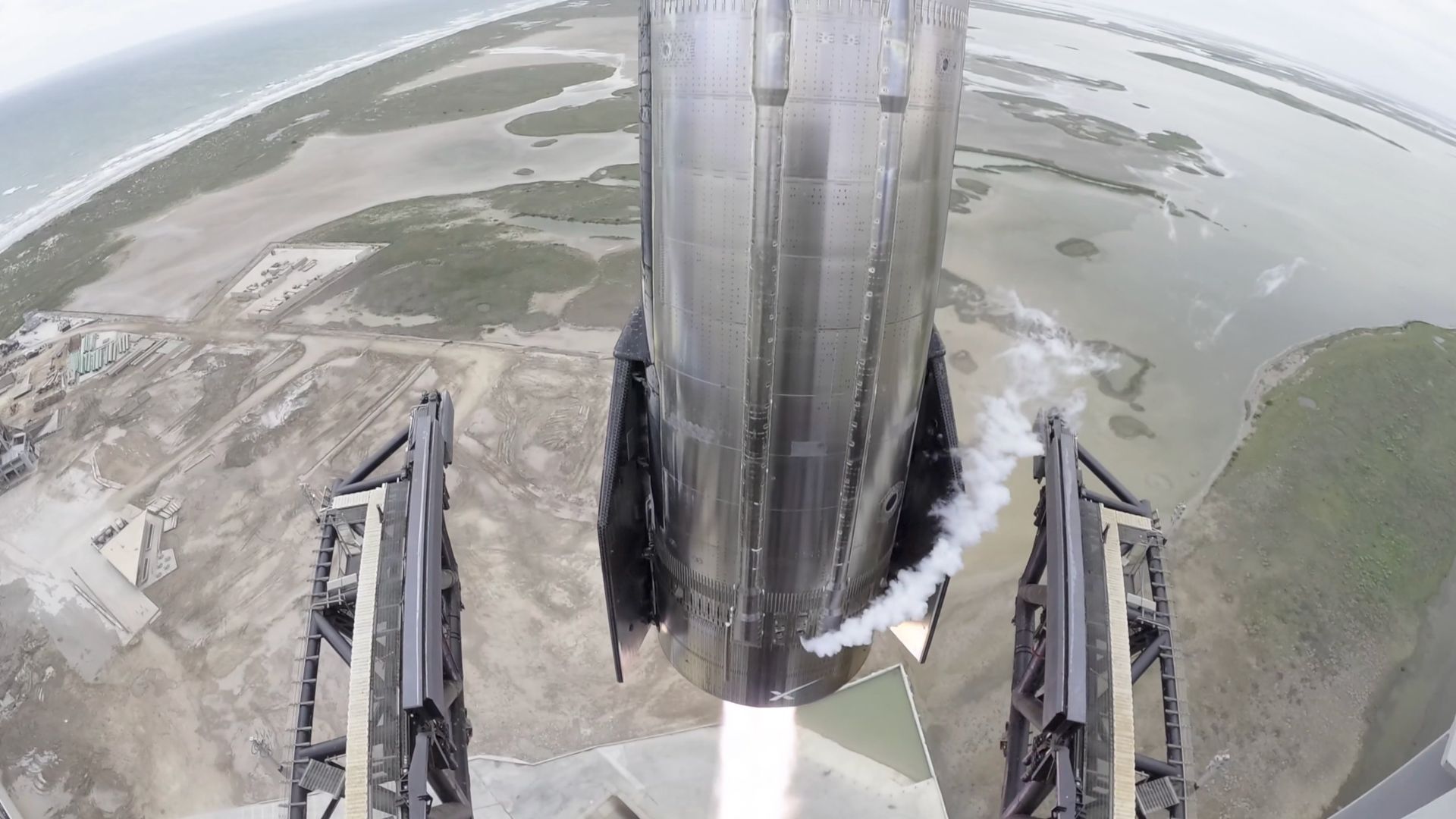
That vehicle, known as Ship 42, launched Nov. 13 on Starship‘s 15th test flight. A day later, it returned from orbit, nestling softly into the “chopstick” arms of its launch tower at SpaceX‘s Starbase site in South Texas.
Ship 42 made it through Flight 15 in good condition, according to SpaceX founder and CEO Elon Musk, who said it “could probably be reflown with a few weeks of refurbishment.” But that’s not going to happen.
“In this case, because it’s kind of an historic ship, we’re going to, I think, not take any chances with the ship and just kind of leave it for public display, because what it’s done is historic,” Musk said on Wednesday (Nov. 18) during a discussion at the TomorrowX Summit.
He didn’t say where Ship would be put on display, but the likeliest locale is Starbase, SpaceX’s Starship manufacturing and launch hub. (SpaceX plans to shift most Starship launches to its new Starbase Louisiana site, but construction has yet to begin on that $100 billion complex.)
Musk participated virtually in the TomorrowX conversation, which was moderated by two friends of his, the venture capitalists Gavin Baker and Antonio Gracias. (TomorrowX took place in Austin, Texas, but Musk was in China on Wednesday as part of President Trump’s delegation for his meeting with Chinese President Xi Jinping.)
The world’s richest man expounded on Ship 42’s historic achievement, explaining that it gets SpaceX much closer to the “holy grail of rocketry” — a fully and rapidly reusable launch vehicle.
Before Flight 15, SpaceX had already caught Starship’s first-stage booster, known as Super Heavy, on three separate occasions, and it had reflown a booster twice. But the company had never attempted a Ship catch, which is a taller order, given how much faster and farther Starship upper stages fly.
So snagging Ship on the first try was a very big deal, according to Musk.
“Everyone knew, within SpaceX, at least, how important this milestone was, and that it was really something fundamental and profound — that Starship will be the first-ever fully reusable orbital space system,” he told Baker and Gracias on Wednesday.
And SpaceX is very serious about Starship reuse. Musk has said that the company wants to launch about 10,000 Starship missions per year by 2030.
This mind-boggling cadence will help the company build out two enormous megaconstellations in low Earth orbit — the next iteration of its Starlink broadband network, which will consist of about 100,000 satellites, and its Starmind AI data-center constellation, which will be 10 times bigger than that.
Assembly of that new Starlink network is already underway. Ship carried 26 of the next-gen internet spacecraft up for the first time on Flight 14, which launched on Sept. 28, and repeated the feat on Flight 15.